

Diseases treated by CEREMAIA
CEREMAIA's adult site at Tenon Hospital deals exclusively with autoinflammatory diseases and inflammatory amyloidosis. The diseases most frequently seen in consultation are:
-
Familial Mediterranean Fever (FMF).
-
Cryopyrinopathies (CAPs).
-
Mevalonate Kinase Deficiency (MKD).
-
TRAPS syndrome.
-
Haploinsufficiency of A20 (HA 20).
-
Still's disease.
-
Schnitzler syndrome.
-
VEXAS syndrome.
-
ADA2 deficiency.
-
Inflammatory amyloidosis (AA amyloidosis).
-
Some diseases are much rarer: NLRP12, PSTPiP1, JAK1, CDC42 mutations, etc.
Autoinflammatory diseases

An autoinflammatory disease is a disease linked to disorders of innate immunity. Innate immunity is immediate immunity. It defends against danger signals picked up by the body's white blood cells.
These signals may be infections, temperature variations, hormonal fluctuations or stress.


Diseases linked to PSTPIP1 mutations
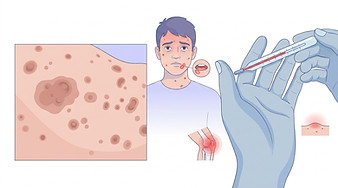
Diseases associated with mutations in PSTPIP1 (proline-serine-threonine phosphatase-interacting protein 1) are rare autoinflammatory diseases. The gene encodes the PSTPIP1 protein, which is involved in the cytoskeleton of cells. In the event of a mutation, patients develop an inflammatory disease known as PAID (PSTPiP1 associated inflammatory disease).

Sitrame Syndrome

SITRAME Syndrome is a probable autoinflammatory syndrome in adults.
No gene known to date.
It is a new clinical entity, with a recurrent macular eruption predominantly on the trunk, associated with systemic inflammation. The acronym "SITRAME" stands for "Systemic Inflammatory Trunk Recurrent Acute Macular Eruption".

H Syndrome

This is a rare genetic autoinflammatory disease first described in 2008.
There are around 200 patients with this disease worldwide to date, mainly in Arab countries and India, but other cases have been described in Europe, Asia and Africa, affecting both men and women.
In the majority of cases, symptoms begin in childhood and the disease is diagnosed in adolescence.
Autoinflammatory actinopathies

Actin is an essential component of the cell, enabling it to organize its shape and contents (known as the cytoskeleton), multiply and interact with its environment.
Actinopathies with autoinflammatory manifestations are a new emerging group of autoinflammatory diseases, linked to defects in the regulation of actin cytoskeleton dynamics in cells.
Recurrent pericarditis

Pericarditis is an inflammation of the pericardium, the membrane that surrounds the heart. Its function is to protect the heart.
These inflammatory episodes occur intermittently and are interspersed with periods of remission.
It can be caused by various factors, such as viral infections, autoimmune or autoinflammatory diseases, but more often than not the cause is not identified (idiopathic pericarditis).
Type I Interferonopathies

This condition is characterized by repeated episodes of pericarditis, which is an inflammation of the pericardium, the membrane surrounding the heart. Its function is to protect the heart.
These inflammatory episodes occur intermittently and are separated by periods of remission.
It can be caused by various factors, such as viral infections, autoimmune or auto-inflammatory diseases, but most often, the cause remains unidentified (Idiopathic Pericarditis)
RELA-Related Disease

RELA is the name of a gene present in all our cells. This gene plays an important role in the functioning of the immune system, which protects us from infections and helps control inflammation. RELA is involved in a process called the "NF-kB pathway," an essential mechanism for responding to stressors such as infections, injuries, or cellular stress.
However, mutations in the RELA gene can disrupt its function and lead to rare diseases. These diseases may manifest as immune and inflammatory problems.



Unclassified Autoinflammatory Diseases

These are autoinflammatory diseases that are currently "unclassified".
Patients present criteria for autoinflammatory diseases after exclusion of differential diagnoses. However, it is not possible to determine a disease defined by a set of criteria, and there are no mutations found in any genetic analyses carried out using techniques available to date.
LACC1 mutation disease

A rare genetic auto-inflammatory disease first described in 2015.
Just under 100 patients described worldwide to date.
Patients are predominantly from the Mediterranean basin (Middle East, North Africa and Turkey), but cases have been described in China, India and Black Africa.
There is a discreet female predominance
In 90% of cases, symptoms begin before the age of 3
As this is a genetic disease caused by mutations in the JAK1 gene, the proposed acronym is JAID for "JAK1 associated inflammatory disease".
Diseases linked to CDC42 mutations

Actin is an essential component of the cell, enabling it to organize its shape and contents (known as the cytoskeleton), multiply and interact with its environment.
Autoinflammatory diseases linked to mutations in CDC42 belong to the family of autoinflammatory actinopathies. These diseases are linked to a defect in the regulation of actin cytoskeleton dynamics, in which the CDC42 protein plays a key role.
Diseases linked to RIPK1 mutations

This is a group of rare auto-inflammatory diseases of recent description (2018). These diseases are caused by mutations in the RIPK1 (Receptor Interacting Protein serine/threonine Kinase 1) gene.
RIPK1 is a key protein in cell metabolism, involved in the regulation of inflammation, cell survival and cell death.
Lysozyme Amyloidosis
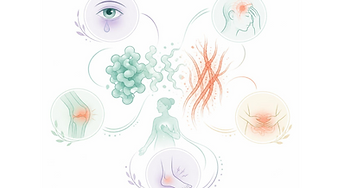
Amyloidosis is a rare disease where normal proteins accumulate abnormally in tissues and organs, disrupting their function. There are different types of amyloidosis, depending on the protein involved.
Lysozyme amyloidosis (ALys) is a rare hereditary form in which amyloid deposits are made up of mutated lysozyme, a protein involved in immune defense, found in fluids such as tears and saliva.
Clonal Hematopoiesis
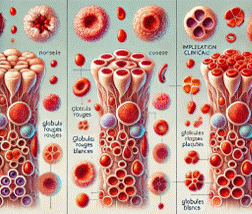
Clonal hematopoiesis refers to the production of blood cells from a single group of modified stem cells in the bone marrow. It becomes more common with age and can be asymptomatic.
However, it may slightly increase the risk of diseases such as leukemia or cardiovascular diseases. Appropriate medical follow-up allows for monitoring this condition
NFKB1-Related Disease

NFKB1 is the name of a gene that is important for the functioning of the immune system. This gene produces a protein that plays a central role in the body's response to infections and inflammation. It is part of the NF-kB pathway, a key mechanism that helps trigger and regulate immune reactions.
When the NFKB1 gene has a mutation, this mechanism can be disrupted. This may lead to a weakened immune system, making the body more vulnerable to infections, or, conversely, cause excessive inflammatory reactions.