top of page

French title: Performance du taux d'interleukine 18 (IL-18) sérique pour la surveillance des patients atteints de fièvre méditerranéenne familiale.

First author: Inès Elhani

Journal: The Journal of Allergy and Clinical Immunology: In Practice (JACIP)

Article traduit par le Dr Catherine Grandpeix-Guyodo


Performance du taux d’interleukine 18 (IL-18) sérique pour la surveillance des patients atteints de Fièvre Méditerranéenne Familiale


Introduction:

Inflammasome activation in Familial Mediterranean Fever (FMF) leads to increased secretion of interleukin (IL)-1β and IL-18. Monitoring FMF activity is essential due to the risk of AA amyloidosis in cases of prolonged inflammation and is classically done using CRP and SAA (serum amyloid A protein), whose values may be dissociated. This study investigated the possibility of monitoring FMF activity through total blood IL-18 assay.

Patients and methods:

This monocentric, retrospective study involved adult FMF patients who had at least one total blood IL-18 assay during their follow-up between 2022 and 2024. The data collected included the mutational status of the MEFV gene, CRP and SAA values, disease activity (considered controlled if fewer than 2 flares per year / uncontrolled if 2 or more flares per year), and finally the total IL-18 assay(s) performed during follow-up consultations (routine care).

Results:

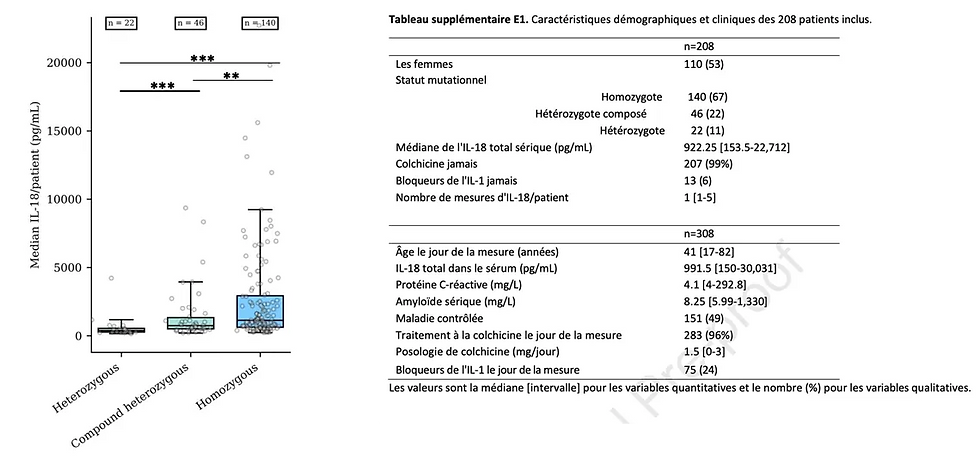
Among 208 sampled patients, half had controlled FMF, and a total of 308 IL-18 assays were analyzable with a median measurement of 922.25 pg/mL (N < 350 pg/mL). Among patients with controlled FMF, IL-18 levels were significantly higher in homozygous patients compared to compound heterozygotes and heterozygotes.

Some patients had IL-18 assays when FMF was inactive and active, and levels showed no significant difference.

IL-18 levels were not significantly different in patients treated with anti-IL-1.

Assays > 7,000 pg/mL concerned 16 patients who had adherence issues with their colchicine treatment and rather low dosages (< 2 mg).

Discussion:

Total blood IL-18 levels appear to be correlated with genotype but not with disease activity. The persistence of high IL-18 levels in asymptomatic patients could suggest low-grade activity of the pyrin inflammasome. Very high levels may show that patients are undertreated, but the significance of IL-18 levels in terms of amyloidosis risk remains to be determined if the SAA level is normal.

The limitations of this study are the few samples per patient (generally 1), the retrospective nature, and the absence of evaluation by a disease activity score at the time of sampling.

Conclusion:

The monitoring of total blood IL-18 levels has a role that remains to be defined since it does not seem to reflect either the patient's immediate inflammatory state or FMF activity. Its interest could lie in detecting subclinical inflammatory activity and evaluating treatment adherence. Prospective studies on large cohorts will be necessary to deepen its utility in FMF.


Figure 1. Median IL-18/patient levels according to genotype in patients with familial Mediterranean fever.


Summary by Dr Catherine Grandpeix-Guyodo

First author: Tuğba Ocak

Journal: Medicina

Reference: Medicina (Kaunas). 2025 Apr 25; 61: 792


Anakinra treatment in colchicine-resistant or colchicine-intolerant Familial Mediterranean Fever: real-world experience

Introduction:

Familial Mediterranean Fever (FMF) is the most common monogenic autoinflammatory disease worldwide. It is associated with MEFV gene mutations and is characterized by recurrent inflammatory attacks, particularly with abdominal pain. The most severe complication is AA amyloidosis. The recommended treatment is colchicine to prevent attacks and complications. In some patients, colchicine at the maximum tolerated dose is insufficient to prevent attacks, while others do not tolerate colchicine. Anti–interleukin‑1 agents are effective in cases of colchicine resistance or intolerance. This Turkish team investigated treatment with anakinra in colchicine‑resistant/intolerant FMF patients, focusing on their clinical characteristics, treatment duration, treatment response, possible extension of injection intervals, and long‑term outcomes.


Patients and methods:

This single‑center retrospective study included 68 FMF patients with colchicine resistance or intolerance who required initiation of anakinra at a dose of 100 mg/day. Colchicine resistance was defined as at least one attack per month despite the maximum tolerated daily dose of colchicine. Colchicine intolerance was defined as the inability to increase the colchicine dose because of digestive side effects.


Results:

Among these 68 patients, the median age was 40.2 years and 57.3% were women. Of the 60 patients who had undergone genetic testing, 32 patients (53%) had two pathogenic MEFV mutations, 26 (43%) were heterozygous for pathogenic mutations, and 2 had no identified mutation.


Fifteen patients had AA amyloidosis. All patients were treated with colchicine before starting anakinra, at a median dose of 2 mg/day, and 63 patients continued colchicine in parallel. Median follow‑up was 34 months.


Treatment was effective in the majority of patients, with significant reductions in the Pras score, ESR, CRP, SAA, and proteinuria when present.


In 21 patients, remission was achieved under treatment, allowing an increase in the interval between anakinra injections to every 2 days, then every 3 days. Eight of these patients were able to discontinue anakinra completely while continuing colchicine alone. Only 2 patients relapsed within the month following complete treatment withdrawal.


The main adverse events were injection‑site reactions.


Seventeen additional treatment discontinuations were reported, mostly due to insufficient response (7 patients) or adverse events (7 patients).


Four patients received anakinra during pregnancy without adverse effects in either the mother or the baby.


Six kidney‑transplant recipients were treated with anakinra, one of whom died from COVID‑19 pneumonia.


Discussion:

This study shows that treatment with anakinra in patients who are resistant or intolerant to colchicine leads to rapid and sustained improvement in clinical signs and inflammatory markers, with good tolerability. Injection intervals could be extended to every 2 or even 3 days while maintaining clinical and biological response. Proteinuria decreased in some patients, suggesting a potential benefit in those with AA amyloidosis. Treatment was also well tolerated, with no adverse effects reported in the 4 pregnant women.


In practice:

In this study of 68 Turkish adults with FMF, anakinra was rapidly effective and well tolerated in the long term in patients who were resistant or intolerant to colchicine.


First author:  Basset et al

Review:  Journal of the American Society of Nephrology

Reference :  DOI :   10.1681/ASN.0000000000000339


Introduction:


Inflammatory amyloidosis is a rare disease secondary to the deposition of serum amyloid A (SAA) protein in the form of insoluble amyloid fibrils, causing predominantly renal damage and dysfunction that may progress to end-stage renal disease requiring dialysis. Renal involvement is almost constant in all cases of AA amyloidosis at the time of diagnosis, while cardiac involvement is uncommon. Unlike the more common forms of systemic amyloidosis, particularly AL and ATTR, AA amyloidosis has not yet been the subject of prospective studies.


Thanks to their ability to accurately predict prognosis without the need for invasive and expensive tests, stratification systems based on biomarkers are playing a well-established role in the management of patients with systemic amyloidosis. For example, stratification systems for overall survival and renal failure have been validated for AL amyloidosis. More recently, two overall survival stratification systems have been validated for transthyretin amyloidosis (ATTR). However, AA amyloidosis has not yet had a validated system for stratifying the risk of renal progression of the disease. In this study, the authors developed and validated a stratification system for overall survival and renal failure in patients with newly diagnosed AA amyloidosis.


Methods :


Patients included.


The databases of the Amyloidosis Research and Treatment Centre in Pavia, Italy, and the Amyloidosis Centre in Heidelberg, Germany, were used. Four hundred and seventy-six consecutive patients with newly diagnosed AA amyloidosis, including 233 in Pavia between 1991 and 2020 and 243 in Heidelberg between 1975 and 2020, were included in the study.


In the absence of a specific consensus on the definition of organ involvement in AA amyloidosis, the authors chose to use the criteria for organ involvement in AL amyloidosis: glomerular filtration rate (eGFR), B-type natriuretic peptide (BNP) and N-terminal BNP (NT-proBNP).


The Italian cohort was used as the test population and the German series as the validation cohort in the analysis.


Statistical analysis


ROC analyses based on survival, death and dialysis of patients with AA amyloidosis at 24 months were used to identify biomarker thresholds, which according to the Youden index, best discriminate between overall survival and renal failure. Median follow-up was estimated using the inverse Kaplan-Meier method. Overall survival was calculated from diagnosis to death (event) or last contact with the living patient.


The stratification system developed in the Pavia cohort was applied to the Heidelberg cohort. Given the good discrimination and calibration, the authors combined the two cohorts for subsequent analyses, in order to make effective use of the information contained in the risk categories and to increase the precision of the associated HR estimates.


Results:

A total of 476 patients were evaluated during the study period (233 in Pavia and 243 in Heidelberg), most of whom (>95%) were diagnosed after 2000 (Table 1). Renal involvement was present in 95% of cases; 33 Italian (14%) and 47 German (19%) patients were already on dialysis at the time of diagnosis respectively.


Differences were observed between the two cohorts: serum albumin levels were higher and German patients were younger than Italian patients. Differences were also observed in the underlying causes of chronic inflammation, with a higher proportion of recurrent infections and idiopathic AA in Italy and more autoinflammatory diseases in Germany. t .


The median follow-up of patients was 67 months in Italy and 36 months in Germany. In the Italian cohort, 58 (25%) patients died and 51 (21%) in the German cohort. No difference in overall survival was observed between the two cohorts (Log-rank test p=0.28).


Among patients who were not on dialysis at the time of diagnosis, 68 (32%) progressed to end-stage renal disease in the Pavia group and 56 (29%) in the Heidelberg cohort.


Identification of biomarker thresholds that best discriminate between overall survival and renal failure


The most discriminating thresholds for overall survival at 24 months in the Pavie test cohort were


- eGFR 45 ml/min/1.73 m2


- 3.0 g/dL for serum albumin


- 40 mg/L for SAA


- 130 ng/L for BNP


- 1000 ng/L for NT-proBNP


The most discriminating thresholds for dialysis at 24 months were


- GFR at 35 ml/min/1.73 m2


- 3.0 g/dL for serum albumin


- 25 mg/L for SAA


- 3 g/24h for 24-hour proteinuria


Prediction of overall survival and stratification system (Table 2)


The stratification system calculated as the sum of the simplified coefficients ranged from 0 to 3. Because of the low number of deaths in certain categories, the authors grouped score 0 with score 1 (low-risk category). This stratification system identified three groups of patients with significantly different survival.


Overall survival at 5 years was 94% (95% CI: 87-98%) in the low-risk category, 80% (95% CI: 62-90%) in the intermediate-risk category and 46% (95% CI: 21-68%) in the high-risk category.


Discussion and conclusion:

This is the first study to propose a stratification system based on non-invasive biomarkers for overall survival and renal failure in AA amyloidosis.


Older age at diagnosis, 24h proteinuria, proteinuria/creatinuria ratio


were confirmed as poor prognostic factors for survival and progression to renal failure.


In conclusion, the authors propose these biomarkers for stratifying overall survival and renal failure with the aim of improving the management of patients with AA amyloidosis by identifying the most severe cases.


Table 2

Table 4


bottom of page